Report
Lower Costs, Better Outcomes

Globally trusted since 2013
The hidden costs of crypto execution
Displayed spreads only tell half the story. Once taker fees are factored in, the true cost of trading on an exchange looks very different.
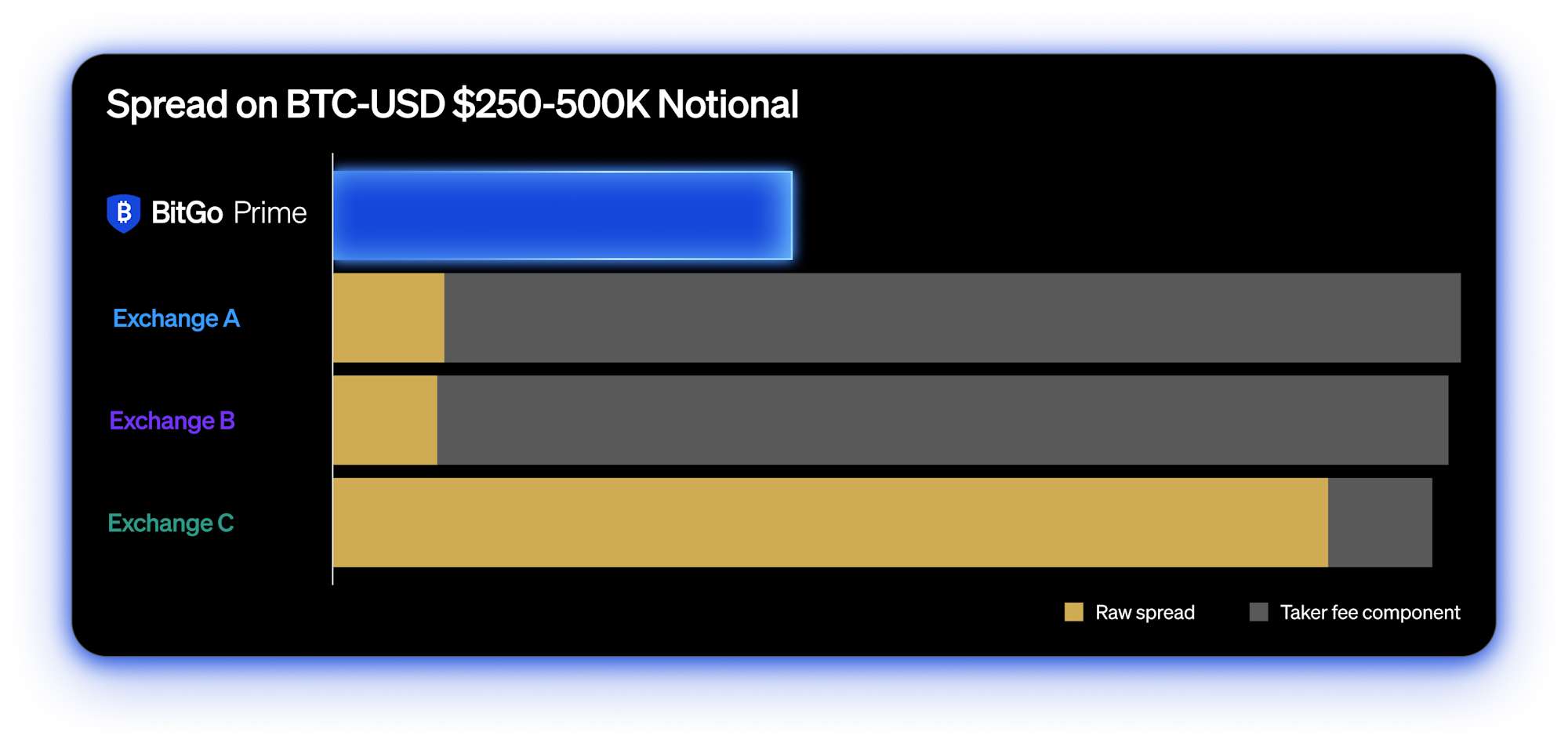
The data proves the difference
Exchanges monetize liquidity through layered fees and pricing tiers, costing you more on the way in and on the way out.
BitGo Prime takes a different approach. We focus on delivering best-executable pricing through deep, aggregated liquidity, ensuring you keep more of every trade.
How BitGo compares
It comes down to the fee model. See how BitGo Prime's all-in pricing stacks up across every category that matters to traders. No subscription fees, no recurring trade fees, and all of the algorithmic trading tools you need.
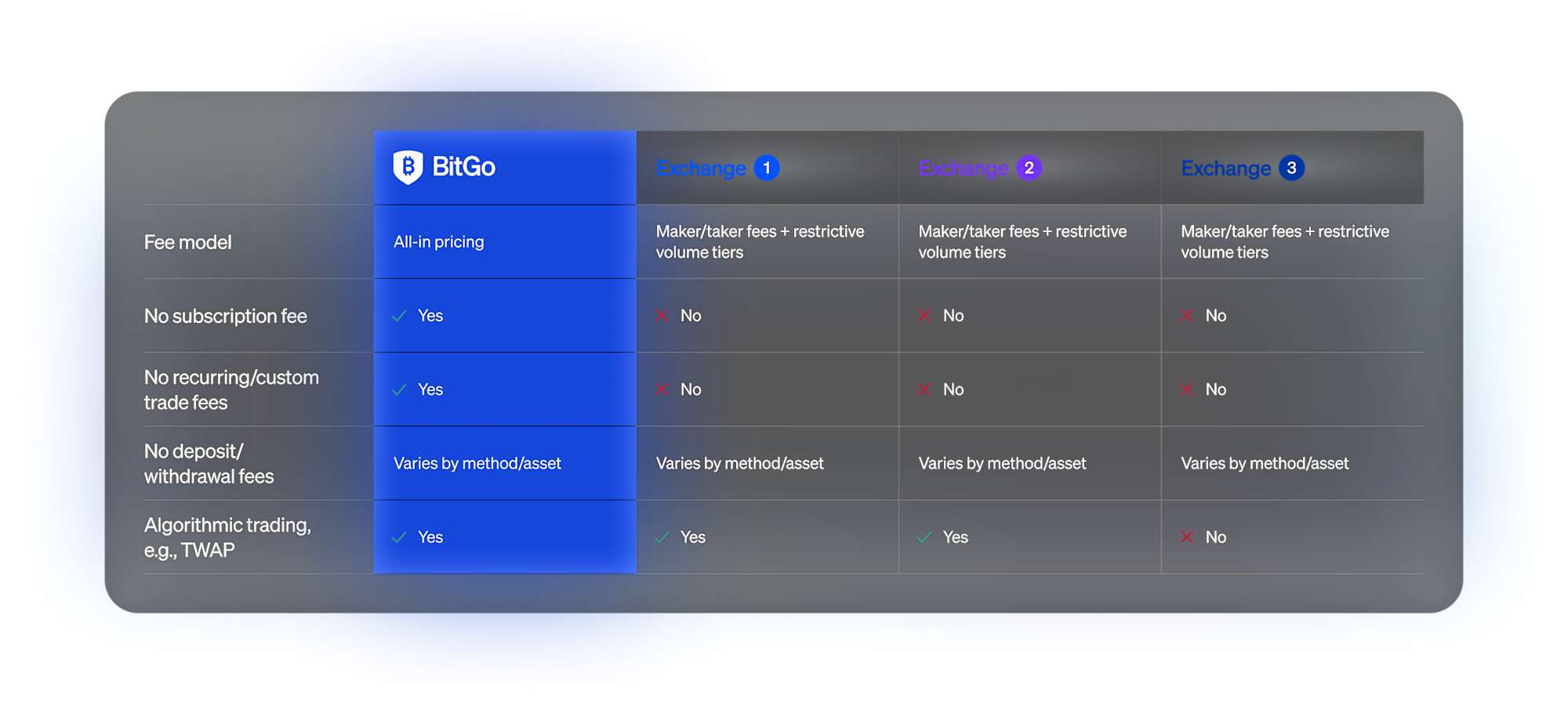
A dfferent kind of trading partner
BitGo Prime is uniquely designed to provide institutions with reliable access to deep liquidity, predictability, and lower execution costs across markets.
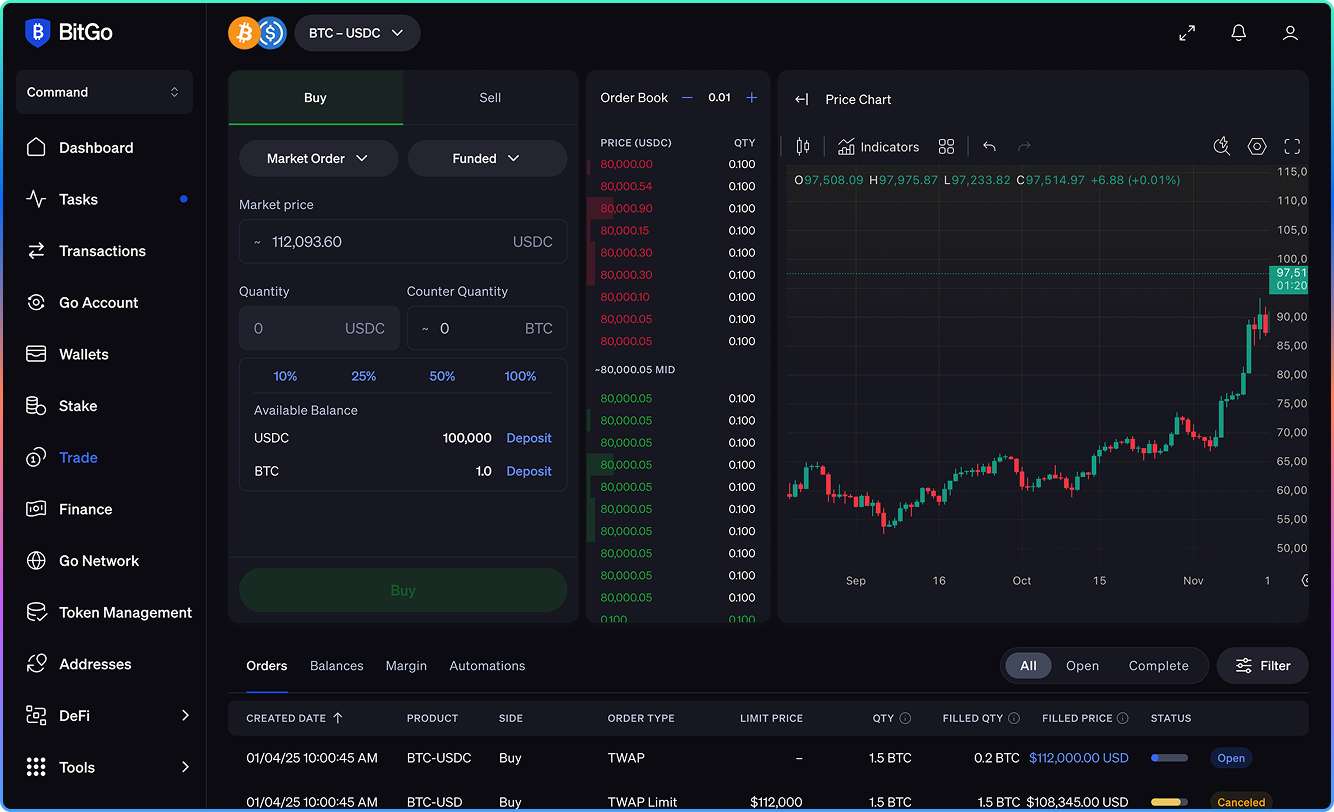
-
Transparent Pricing
All-in institutional pricing with no maker/taker fees, no premiums, and no volume-tier pricing or subscription models.
-
Aggregated Liquidity
Deep aggregated liquidity from the industry’s top liquidity providers, market makers, and other venues, designed to help you get the best price through all market conditions
-
Maximum Security
Assets stay in your name, segregated, and insured up to $250M when held in qualified custody while trading.
Built for every way institutions trade
BitGo Prime helps you trade safely and efficiently across spot, credit, and derivatives markets. With support for thousands of coins and tokens, BitGo provides the unified trading platform for all of your strategy needs.

FAQs
Why isn't the quoted spread enough to compare crypto trading venues?
Why isn't the quoted spread enough to compare crypto trading venues?
The quoted spread reflects only one component of trading costs. Exchange fees, liquidity availability, execution quality, and market conditions all influence what an institution ultimately pays to complete a trade. Comparing fee-inclusive execution costs provides a more complete picture of trading performance.
What is fee-inclusive execution cost?
What is fee-inclusive execution cost?
Fee-inclusive execution cost represents the total cost of completing a trade after both the quoted spread and applicable trading fees are considered. Because different venues use different pricing models, fee-inclusive pricing allows institutions to make more meaningful comparisons across trading providers.
What is all-in pricing?
What is all-in pricing?
All-in pricing incorporates the full cost of execution into the quoted price rather than separating spreads and execution fees. This gives traders greater transparency into what they will actually pay to complete a transaction.
Why do exchange trading fees matter?
Why do exchange trading fees matter?
While many exchanges advertise competitive spreads, trading fees can materially increase the total cost of execution. For institutional trading programs, even small fee differences can compound into significant costs over time.
What is the difference between execution quality and quoted pricing?
What is the difference between execution quality and quoted pricing?
Quoted pricing reflects the price displayed before a trade is executed. Execution quality measures the actual outcome, including fees, liquidity access, market impact, and the final price achieved. Institutions increasingly evaluate trading providers based on execution outcomes rather than quoted prices alone.
Why does market volatility affect execution costs?
Why does market volatility affect execution costs?
Periods of market volatility often result in wider spreads, changing liquidity conditions, and higher trading costs. Evaluating execution performance during volatile markets provides a more complete picture of how trading providers perform when execution quality matters most.
Why is liquidity aggregation important?
Why is liquidity aggregation important?
Liquidity aggregation combines pricing from multiple exchanges, market makers, and OTC liquidity providers into a single execution network. This can improve pricing opportunities, increase available liquidity, and help institutions achieve more consistent execution outcomes across different market conditions.
How should institutions evaluate crypto trading providers?
How should institutions evaluate crypto trading providers?
Institutions should look beyond headline spreads and consider total execution costs, pricing consistency, liquidity access, operational resilience, settlement capabilities, security, and the ability to deliver reliable execution across different market environments.
Why did BitGo commission this research?
Why did BitGo commission this research?
As institutional participation in digital assets continues to grow, execution quality is becoming an increasingly important differentiator. BitGo commissioned this research to better understand how fee-inclusive execution costs compare across trading venues and to provide institutions with a data-driven framework for evaluating execution beyond quoted spreads.
How was the research conducted?
How was the research conducted?
The report analyzes more than 700,000 matched quote observations across BTC, ETH, SOL, XRP, and DOGE using market data captured through the Talos platform. The analysis compares fee-inclusive execution costs, pricing consistency, and trading outcomes across BitGo Prime and four major exchanges. Additional details regarding the methodology, assumptions, and limitations are included in the report.
Who should read this report?
Who should read this report?
This research is intended for institutional investors, hedge funds, asset managers, trading firms, treasury teams, ETF issuers, corporate treasury professionals, family offices, and anyone responsible for evaluating digital asset trading infrastructure or execution providers.
Smarter trading
starts here