Receive addresses
Wallet-as-a-Service
Scalable Crypto Wallet Solutions
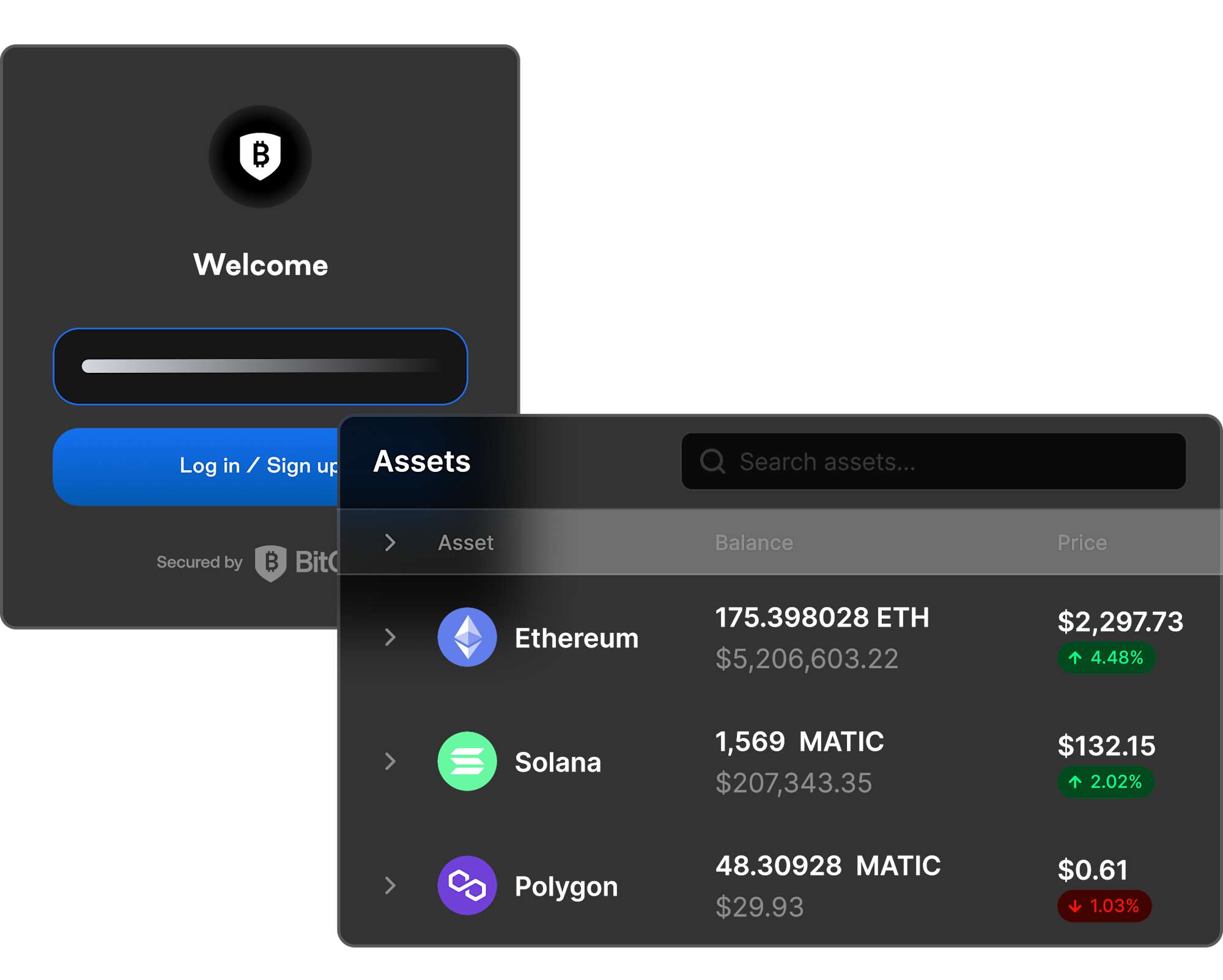
Programmatically create and manage wallets for your business and receive addresses for your end users.
Globally trusted since 2013
Best for
Growing Your Platform
Leverage our wallet infrastructure instead of hiring extra blockchain engineers and security experts.
Key management
Wallet-as-a-Service
Key management works the same as a regular self-custody hot wallet, with the ability to generate receive addresses for each of your end users.

Wallet-as-a-service
Wallets Designed for Your Business
Seamlessly create and scale self-custody hot wallets.
-
Seamlessly create and scale wallets
Create and scale custody wallet infrastructure through a modular approach, with a streamlined and intuitive developer experience.
-
Scale on top of our infrastructure
Focus on improving your core product instead of reinventing wallets from scratch. Combine our wallets with your ledger to solve a key infrastructure challenge in a secure way.
-
Build to your needs
Craft "open loop" or "closed loop" systems based on your control preferences, while combining programmatic self-custody hot wallets with custody wallets and trading accounts to access both cold storage and liquidity.
-
9.3M+ Wallets Created
-
1700+ Assets Supported
-
$3T Lifetime Transactions
Build Your Digital Asset Exchange, One Feature at a Time
-
-
REST APIs
Build on our APIs and SDKs through a single interface.
-
Transaction signing
Create, sign, and monitor transactions for your end-users.
-
Whitelisting
Control where your assets can go.
-
Velocity Controls
Cap how much can move in a given timeframe.
-
User Management
Set roles and permissions on an individual level.
Supporting Thousands of Businesses Around the World
Frequently Asked Questions
How much engineering effort is it to embed wallet-as-a-service into our existing product?
How much engineering effort is it to embed wallet-as-a-service into our existing product?
Embedding BitGo wallet-as-a-service uses REST APIs and SDKs to create wallets and addresses, apply policies, sign transactions, and monitor activity. Engineering effort depends on your ledger, user experience, compliance stack, and supported assets, with BitGo’s modular design allowing a focused initial integration.
With wallet-as-a-service, do our end users control their keys, or do we, or does BitGo?
With wallet-as-a-service, do our end users control their keys, or do we, or does BitGo?
BitGo wallet-as-a-service uses a self-custody multi-key model in which your organization controls the client key and backup key, while BitGo, Inc. protects a platform co-signing key in a hardware security module. Your product design determines whether end users receive direct key control or interact through permissions you manage.
How does this scale if we go from thousands to millions of wallets?
How does this scale if we go from thousands to millions of wallets?
BitGo’s wallet infrastructure has supported millions of wallets and more than 2,200 assets as of June 2026, with programmatic wallet and address creation through a single API layer. Modular services let you scale signing, policies, monitoring, and asset support without rebuilding the wallet core.
How are responsibilities allocated once we put wallets in front of our users?
How are responsibilities allocated once we put wallets in front of our users?
Responsibilities are allocated in your agreement with BitGo, Inc. or the BitGo regulated entity and depend on the key-control model you choose. In the standard wallet-as-a-service self-custody model, your organization controls the majority of keys, while BitGo provides secure wallet infrastructure and policy-based co-signing.
What compliance, KYC, and travel-rule tooling comes built in?
What compliance, KYC, and travel-rule tooling comes built in?
Wallet-as-a-service includes wallet security, policy, address-whitelisting, velocity-limit, and role-management tools. KYC, KYB, transaction monitoring, and travel-rule workflows can be added through BitGo’s broader crypto-as-a-service stack or integrated compliance providers.
What happens to our users' wallets and assets if we migrate off the platform?
What happens to our users' wallets and assets if we migrate off the platform?
Your organization retains control of the majority of keys, and BitGo cannot unilaterally move customer assets because it holds only one of the three keys. If you migrate off the platform, you can transfer assets to replacement wallets using documented recovery and migration procedures. Transaction histories, wallet data, key backups, and contractual data-retention terms support an orderly platform migration.
What uptime commitments and SLA apply, and what happens when something breaks?
What uptime commitments and SLA apply, and what happens when something breaks?
The service agreement and the BitGo Service Level Agreement define uptime commitments, enterprise support, incident response, and any contractual remedies. API monitoring, policy controls, and BitGo’s institutional support process provide operational coverage when an incident occurs.
Wallet-as-a-Service is provided through our BitGo Inc. entity. Learn more.
Build Your Digital
Asset Strategy